Crawl Space Water Damage in Lafayette, CA
Water that gathers beneath a house after a storm or a pipe failure stays hidden while it soaks insulation, joists and soil. The crew pumps it out, strips what is wet and dries the space.
(888) 774-9605Request crawl space water removal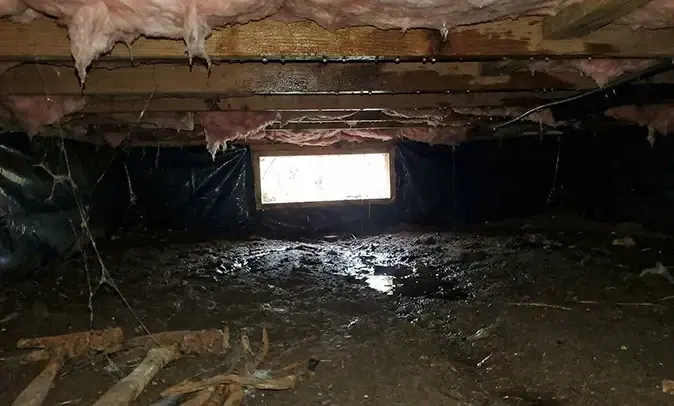
First steps for crawl space water damage in Lafayette
- 1
Stay out if sewage
Do not enter a crawl space holding sewage or deep water, and keep children and pets away.
- 2
Turn off the source
Shut the main valve if a pipe or heater is leaking above the crawl space.
- 3
Cut power to the space
Switch off any circuit feeding lights or outlets beneath the house.
- 4
Photograph from the access
Take pictures of visible water and any wet insulation from the access hatch.
How crawl space water damage work is done in Lafayette
Not every Lafayette house has a crawl space, but where one exists it is the lowest point under the floor and the first place groundwater, runoff or a leaking pipe collects. Lafayette has hillside lots, creek channels and many homes from the 1950s to the 1980s, so water finding its way beneath a house after a storm is a real possibility. Problems down there stay out of sight, which lets damage build for weeks.
What does crawl space water damage cost in Lafayette, CA?
A small clean-water leak under a house runs $1,800 to $4,000, storm runoff that leaves silt behind $4,000 to $8,500, and sewage or long exposure $8,500 to $14,000. Insulation, soil treatment and drying time decide the band.
Small clean-water leak
$1,800 to $4,000
- Pump-out
- Wet insulation removed
- Dehumidifier drying
Storm runoff
$4,000 to $8,500
- Debris and silt cleared
- Antimicrobial on soil
- Vapor barrier replaced
Sewage or long exposure
$8,500 to $14,000
- Category 3 protocol
- Full insulation removal
- Extended framing drying
Ranges are typical, not a quote: category of water, square footage, material class and how fast drying started move the number most. Run the water damage cost calculator for a closer range.
The crawl space water damage process in four steps
The tech who does the walkthrough maps moisture before any equipment goes down, so the drying plan matches what is actually wet. Equipment stays until the readings say dry, not until it looks dry.
- 1
Pump and clear
Standing water, silt and debris are removed from the space.
- 2
Strip the wet
Soaked insulation and torn vapor barrier come out.
- 3
Treat the soil
Antimicrobial goes on the soil and exposed framing.
- 4
Dry and verify
Dehumidifiers run until joists read dry.
How water gets under a house
Several routes lead to the same wet space, and each one calls for a different fix after the water is out.
- Storm runoff that crosses a lot and finds a low vent or wall opening
- A leaking supply pipe or drain running through the joists
- A failed water heater or appliance drain above the floor
- A sewage backup from the lateral beneath the house
- Groundwater rising after a stretch of heavy winter rain
What the cleanup includes
A pump or wet vacuum clears standing water first, then debris and silt are cleared by hand. Wet insulation hangs heavy and holds moisture against the subfloor, so it comes out, along with any vapor barrier that is torn or soaked.
The soil is treated with an antimicrobial, a new vapor barrier is laid where needed and dehumidifiers run until the joists and subfloor read dry. Structural drying records show when equipment can leave.
Storm water and sewage under the house
The city says clogged storm drains are the most common cause of flooding in its residential neighborhoods, and a creek flowing through a property is the owner's job to maintain. Both can push water toward a foundation. Sewage is a different category: if the lateral is the source, the owner is responsible for the pipe, and the space is handled with full containment, as covered under sewage backup cleanup.
- Silt and debris cleared before treatment
- Antimicrobial applied to soil and framing
- Vapor barrier replaced if torn or soaked
- Dehumidifiers placed with ducted airflow
Trade note: moisture in a crawl space is checked at the joists and the underside of the subfloor, because that wood is what the home actually rests on.
Crawl space water damage across Lafayette and nearby towns
Crawl space calls reach ZIP 94549, including hillside Happy Valley, Reliez Valley, Springhill, Burton Valley, Silver Dell, Tanglewood and Downtown Lafayette, plus properties near Lafayette Creek and Las Trampas Creek.
The same service nearby: crawl space water damage in Danville, Moraga, Walnut Creek.
Related water damage services in Lafayette
Crawl Space Water Damage questions in Lafayette, CA
Does every Lafayette home have a crawl space?
No. Foundation types vary, so the first step is checking what is under the house and whether water has reached it.
Can wet insulation stay if it dries?
Insulation that has soaked usually cannot be dried in place and loses its value, so wet batts are removed and replaced after the framing dries.
Is storm water in a crawl space dangerous?
Runoff carries soil and bacteria, so the space is cleaned, treated and dried, and anyone entering should wear protection or leave the job to the crew.
How long does drying under a house take?
Several days is common once the water is out, though joists and subfloor hold moisture longer than carpet, and readings decide the finish.
Who maintains drainage around the house?
Owners maintain swales, channels and storm drains on private property, so fixing the drainage that sent water under the house falls to the owner.
What if sewage is the source?
The area is contained and treated as Category 3, with porous materials removed, and the owner is responsible for the lateral that failed.
Still dealing with it?
Water under the house? Describe it and the crew will explain the plan.
Hidden water under a Lafayette house keeps soaking the framing
Send photos from the access hatch, and the crew outlines pump-out, treatment and drying.
(888) 774-9605Request crawl space help