Structural Drying and Dehumidification in Danville, CA
Surface dry is not dry. The drying team runs air movers and dehumidifiers matched to the class of loss and keeps them running until the slab, subfloor and framing read dry, not just the carpet.
(888) 774-9605House wet inside the walls? Start the dry-out now.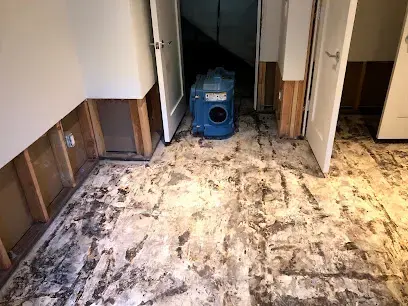
First steps for structural drying and dehumidification in Danville
- 1
Leave equipment running
Keep air movers and dehumidifiers on, day and night.
- 2
Keep doors and windows shut
Outside air slows drying unless the drying team says otherwise.
- 3
Do not move equipment
Each unit is placed for a reason; ask before moving it.
- 4
Note any odor
A musty smell or new stain is worth reporting at the next reading.
How structural drying and dehumidification work is done in Danville
Structural drying is the part of a water loss that nobody sees and everybody pays for if it is skipped. Carpet can feel dry in a day while the subfloor, the bottom plate of the wall and the concrete under it are still wet. Closing that up leads to warped floors, failed adhesive, odor and growth inside the 24 to 48 hour mold window. In Danville, the materials are a mix of slab, crawl-space framing, site-finished hardwood and plaster or drywall in larger two-story homes.
What does structural drying and dehumidification cost in Danville, CA?
In Danville, CA, structural drying typically runs $1,200 to $15,000, depending on the class of loss, how many rooms are drying and whether dense materials such as a slab or hardwood need desiccants or mats.
Class 1 to 2
$1,200 to $3,500
- Air movers and LGR
- Three to four days
- Daily readings
Class 3
$3,500 to $8,000
- Walls and ceilings
- Cavity drying
- More equipment
Class 4
$8,000 to $15,000
- Slab or hardwood
- Desiccants and mats
- Longer drying
Ranges are typical, not a quote: category of water, square footage, material class and how fast drying started move the number most. Run the Danville water damage cost calculator for a closer range.
The structural drying and dehumidification process in four steps
The tech who does the walkthrough maps moisture before any equipment goes down, so the drying plan matches what is actually wet. Equipment stays until the readings say dry, not until it looks dry.
- 1
Map
Moisture mapping sets the category, class and wet area.
- 2
Place
Equipment placed to the evaporation load of each area.
- 3
Monitor
Readings and psychrometric data logged daily.
- 4
Verify
Equipment leaves when every material reads dry.
Class of loss sets the equipment
The IICRC S500 standard groups losses by how much water soaked in and how hard the materials are to dry. The class decides how many air movers and how much dehumidification a room needs.
- Class 1: part of a room, little wicking
- Class 2: a whole room, water up the walls a short way
- Class 3: water from above, walls and ceilings soaked
- Class 4: dense materials such as concrete, hardwood and plaster
The equipment and how it is placed
Air movers sweep air across wet surfaces to speed evaporation. LGR dehumidifiers pull the moisture out of the air so it does not settle back into the materials. Desiccant dehumidifiers and drying mats handle Class 4 work such as a slab or hardwood floor. Wall cavities get air through small holes at the base or along a flood cut. The tech who does the walkthrough places each piece by the moisture map, not by habit.
Crawl spaces under raised homes are dried as their own zone, because damp air there rises into the living space. See crawl space water damage for that work.
Readings decide when it is done
Every day the drying team records material readings, temperature and relative humidity inside and outside the drying area. Equipment moves as rooms dry and comes out only when every material is within 2 to 4 points of a dry reference material in an unaffected part of the home. Try the drying time estimator for a typical window, and see slab leak water damage for a Class 4 example.
- Moisture map on day one
- Daily psychrometric logs
- Final readings recorded for the claim
The EPA indoor air quality pages explain how humidity affects a home, and UC Agriculture and Natural Resources publishes guidance on drying out a home after a flood.
LGR stands for low grain refrigerant: these dehumidifiers keep pulling water out of air that is already fairly dry, which a household unit cannot do.
Structural drying and dehumidification across Danville and the San Ramon Valley
The Danville restoration crew covers ZIP 94526 and 94506, from Downtown Danville and Hartz Avenue out along Diablo Road, Sycamore Valley and Camino Tassajara to Greenbrook, Montair and Blackhawk.
Nearby coverage reaches Alamo, San Ramon, Walnut Creek, Lafayette, Moraga, Clayton.
Related water damage services in Danville
Structural Drying and Dehumidification questions in Danville, CA
What is the difference between drying and structural drying?
Surface drying stops at what you can see. Structural drying reaches the subfloor, framing, wall cavities and slab, and it is measured with meters.
How long does structural drying take?
Usually three to five days for Class 1 to 3. Class 4 losses such as a wet slab or hardwood take longer.
Why can't I turn the equipment off at night?
Drying is continuous. Turning it off lets humidity rebuild and adds days to the job.
Why is it so loud and warm?
Air movers move a lot of air, and dehumidifiers give off heat as they pull water out. Both speed drying.
How is dry measured?
Materials are dry when they read within 2 to 4 points of a dry reference material in an unaffected part of the home.
Is structural drying covered by insurance?
When the water damage itself is covered, drying is usually part of it. Check with your own insurer about your policy.
Still dealing with it?
Wet walls or floors in Danville? Get them dried to the standard.
House still damp after a leak? Get the drying started today.
Hidden moisture in framing and floors keeps doing damage until it is measured and dried.
(888) 774-9605Danville drying team, any hour