Danville gets almost all of its rain from November to April, and the first big storm of the season is when a tired roof gives itself away. Hot, dry summers age roofing and flashing, and the first wet weather finds every weak spot. This post explains what a first rain leak looks like, why attic insulation hides it, and how the ceiling is dried.
Key takeaways
- Nearly all of Danville's rain falls from November to April, often in multi day atmospheric river storms.
- The October 2021 atmospheric river and the late December 2022 to January 2023 storm series saturated the East Bay hills.
- A leak can soak attic insulation long before a stain shows on the ceiling.
- Wet insulation is removed, since it holds water against the ceiling and does not dry well in place.
- A roofer repairs the roof; a restoration crew dries the ceiling, walls and attic framing.
Why the first rain shows weak spots
A Mediterranean climate sends nearly all of Danville's rain between November and April. Months of heat and sun then leave roofing, sealant and flashing dry and brittle.
The first heavy storm tests all of it at once. Wind driven rain can push water past a seam that would hold in a gentle shower.
Roof problems are easy to ignore in a dry season. A crack that lets in no water in September can let in a lot in November.
- Shingles that have curled, cracked or lifted.
- Flashing around chimneys, skylights and vents.
- Valleys where two roof slopes meet.
- Gutters and downspouts clogged with leaves.
Storm series that tested Danville roofs
The October 2021 atmospheric river and the storm series from late December 2022 to January 2023 saturated the East Bay hills. Both were multi day events, which is hard on any roof.
San Ramon Creek runs through town, with Green Valley Creek and Sycamore Creek nearby, and Las Trampas Ridge rises to the west with Mount Diablo to the east. A wet winter can mean days of rain with little time to dry between bands of storms.
Large homes have more roof to test. Many Danville houses are big and two story, with several roof planes, valleys, vents and chimneys, and every one of those is a place where water can find a way in.
A roof that held through a light season can still leak when a long storm arrives, so a leak in a fall or winter storm is not a sign of sudden failure.
- Multi day storms keep roofing wet for a long time.
- Wind can drive water under shingles and into attic space.
- Leaks that start small can grow as the soil and the hills stay saturated.
Signs of a roof leak after rain
A roof leak does not always drip. Many show up as stains, bubbling paint or a soft ceiling long before water falls.
A leak found early in a storm costs far less to dry than one found weeks later.
Signs inside the house
Look at ceiling corners, the walls beneath roof valleys and any ceiling below the attic.
- Brown or yellow ceiling stains.
- Paint that bubbles or peels.
- A ceiling that sags or feels soft.
- Damp or musty smell in an upstairs room.
Signs in the attic
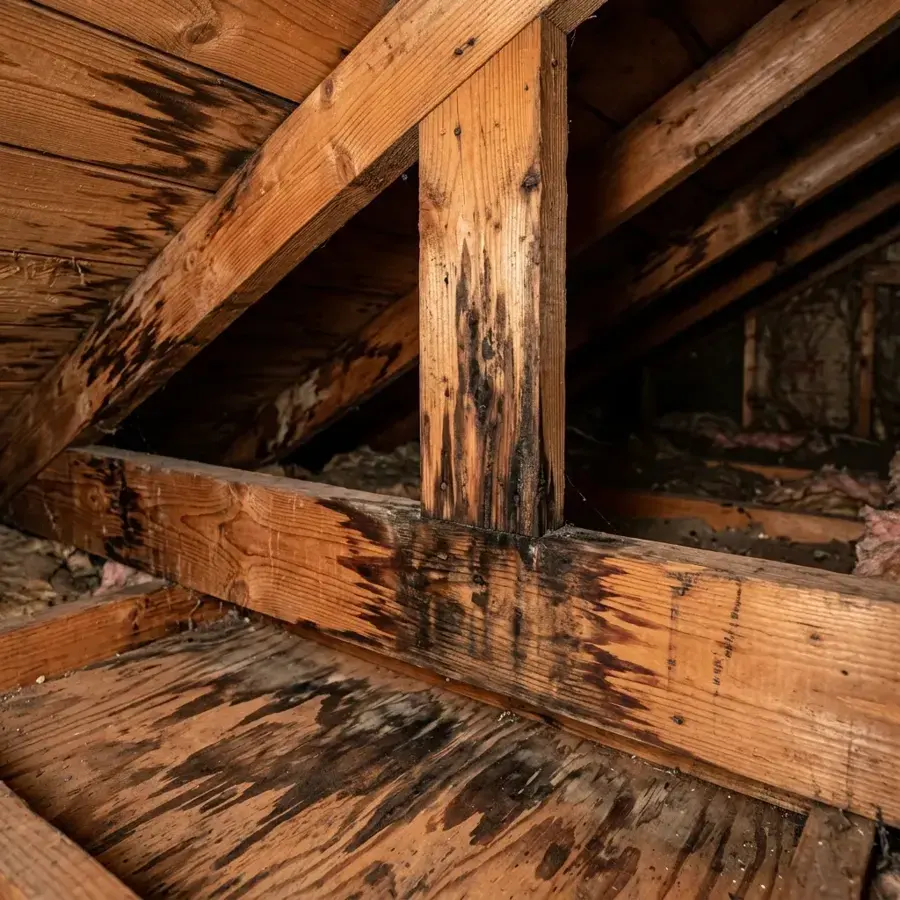
The attic often tells the story first. Damp or flattened insulation, dark stains on the roof deck and dripping at nails or vents all point to a leak.
- Wet or compressed insulation.
- Dark stains on the roof deck.
- Daylight at the roof deck or a vent.
How wet attic insulation hides a leak
Insulation soaks up water like a sponge and keeps it against the ceiling. The leak can go on for days before water reaches the drywall.
By the time a stain shows, the insulation above it may be heavy with water and the ceiling may be softening. Large two story homes built after Interstate 680 have a lot of attic area where this can happen unseen.
Rain that blows in at a vent or ridge may land far from the place where a stain appears, since water follows rafters and ceiling joists.
- Wet insulation holds water against the ceiling.
- Compressed insulation loses its value even after drying.
- Wood in the attic can stay damp long after the rain stops.

What the dry out involves
A roofer should stop the leak first, with a tarp or a repair. The restoration crew then takes moisture readings and decides what comes out.
Wet insulation is pulled. Ceiling drywall is opened where readings show it is wet or sagging, and the cavity is dried with air movers and dehumidifiers.
A roof leak water damage job follows these steps, and the ceiling is dried in place when readings allow. When water has traveled through the ceiling into a room, it becomes a ceiling leak water damage job.
Drying time depends on how much insulation and drywall got wet. A small stain may dry in place over a few days, while a larger leak that has run through an attic can take a longer, staged dry out.
- Tarp or temporary roof repair.
- Wet insulation removed.
- Ceiling opened where readings call for it.
- Daily readings until the attic and ceiling are dry.
What to do the night a ceiling starts dripping
A drip during a storm is stressful, and the first steps matter more than the cleanup that follows. The goal is to limit water and keep everyone safe.
- Move furniture and rugs out from under the drip.
- Place a bucket or large container under it.
- Turn off lights and fans on that ceiling if water is near the fixture.
- Do not poke a bulging ceiling.
- Photograph the stain, the drip and the time.
Checks before the rainy season and after a storm
A few simple checks in the fall can catch problems early. Most can be done from the ground or from inside the attic without climbing on the roof.
After a storm, a quick look at ceilings and the attic can catch a leak while it is still small. Larger drying jobs may need structural drying once water has reached walls and framing.
Danville's large homes often have attics that run the length of the house. A leak at one end can spread a long way before it appears at the other.
- Look at the roof from the ground for missing or lifted shingles.
- Check that gutters and downspouts are clear.
- Look in the attic for damp insulation or stains after the first storm.
- Photograph any damage for the insurer.
Questions
When does it rain most in Danville?
Nearly all rain falls from November to April, often in multi day atmospheric river storms.
Why is wet insulation removed?
It holds water against the ceiling and does not dry well in place, so it is pulled and replaced after drying.
Can a ceiling be dried without opening it?
Sometimes. Readings decide whether a ceiling can be dried in place or has to be opened.
Who fixes the roof?
A roofer repairs the roof. The restoration crew dries the ceiling, walls and attic framing.
Should a bulging ceiling be touched?
No. It may hold a lot of water, so it is best left to a professional.
Is a roof leak covered by insurance?
Policies differ. Sudden storm damage is often treated differently from long term wear, so photos and readings from the first day help the insurer decide.